

Mindfulness in Recovery Within Our Residential, PHP, IOP, and Virtual IOP Programs
Recovery asks you to do something difficult: to stay present with cravings, emotions, and stress that you may have spent years trying to escape. Mindfulness in recovery gives you a practical framework and concrete, learnable skills to notice what is happening in your mind and body, and to respond with intention rather than reaching automatically for a substance.
Our team integrates mindfulness in recovery alongside comprehensive residential treatment and detox support, psychiatric care, individual and group psychotherapy, and family programming—a coordinated approach designed to address addiction at every layer.
What is Mindfulness in Recovery for Addiction Treatment?
Mindfulness is the practice of paying attention to the present moment (your thoughts, feelings, body sensations, and surroundings) with openness and without judgment. In addiction treatment, that simple idea becomes a clinical tool.
Much of substance use is automatic. A trigger appears, discomfort rises, and the urge to use takes over before there’s any conscious choice. Mindfulness creates a pause inside that loop, so you can notice what’s happening and choose a different response.
More than meditation. Sitting quietly is one way to build the skill, but mindfulness in recovery is broader than that. In practice, it can include:
- Mindful breathing to steady yourself in a stressful moment
- Body awareness to catch tension and early warning signs
- Grounding practices you can use anywhere, in seconds
- Urge observation: watching a craving rise and pass instead of obeying it
In structured care, these practices are often taught through recognized approaches like Mindfulness-Based Relapse Prevention (MBRP), Mindfulness-Based Stress Reduction (MBSR), and Mindfulness-Based Cognitive Therapy (MBCT). Each pairs mindfulness with the cognitive-behavioral skills already used widely in addiction and substance use disorder treatment.
What mindfulness is — and isn’t
Mindfulness is a supportive, complementary practice. It is not a replacement for therapy, medical care, or medication when those are clinically indicated. Research on mindfulness for substance use is still developing, and the honest framing is simple: it may help with cravings and emotional regulation when it’s part of a coordinated treatment plan.
Mindfulness-informed treatment may help reduce trauma-related symptoms that often accompany addiction and substance use disorders, though research specific to substance use outcomes is still developing.
Why Trauma and Addiction Are So Often Connected
For many people, substance use does not begin as recreation. It begins as a way to manage something overwhelming: anxiety, intrusive memories, chronic shame, loneliness, or the lingering effects of trauma. At Foundry Steamboat, trauma is central to how we understand addiction, not a side issue, and mindfulness is one of the skills we use to help you make sense of cravings, reactivity, and difficult emotions as nervous-system responses rather than personal failures.
In our men’s residential program, mindfulness supports stabilization, offering the consistency and structure to build the habit without the pressures of daily life. In PHP and IOP, the focus shifts toward applying these skills to real-world contexts: work, relationships, parenting, and the moments where old patterns try to take over. Virtual IOP brings the same framework into your home environment, where many of the cues that trigger use actually live. This continuity matters.
Mindfulness also has to be introduced thoughtfully for trauma survivors. Turning attention inward can sometimes intensify distress at first, which is exactly why we deliver it within a broader, trauma-aware clinical framework: paced, guided, and integrated with the rest of your care rather than practiced alone.
An Introduction to the Foundry Steamboat Men’s Residential Addiction Treatment Program
Gender-specific care makes addiction treatment more effective by tailoring programming around the needs of men and creating a comfortable environment where they feel open and engaged.
Deeply ingrained stigmas about addiction and stereotypes about manhood can be sources of profound stress and cause men to suffer in silence. Much of our work focuses on addressing and dispelling these myths, helping men live happier, more authentic lives.
We also address the common and debilitating problem of trauma and neglect, which men can experience at any point in their lives. Our trauma-integrated approach includes evidence-based modalities such as mindfulness in recovery, which may help regulate our sense of safety, connection, and threat.
Our highly experienced clinicians, technicians, nurses, doctors, and case managers are specially trained to maintain an emotionally and physically safe environment where clients feel supported and encouraged to do the hard work of treatment.
We’re here to do the work.
- Rigorous schedule of clinical therapy
- High staff-to-client ratio
- Integrated trauma therapy
- Compassionate and involved care team
- Integrated family program
- Comfortable and distraction-free treatment environment
- High quality ongoing care planning
How Mindfulness in Recovery May Support Addiction Treatment
For many adults in treatment, addiction is not only a behavioral or chemical problem — it is also a problem of how the mind and body handle stress, craving, and emotion. Mindfulness gives both clinicians and clients a practical way to work with that directly.
The benefits our clinical team sees most often include:
- A new way to understand cravings. Through practices sometimes called “urge surfing,” a craving can be observed as a temporary wave that rises and falls — rather than an emergency that must be answered, or evidence of weakness.
- Reduced shame. Recognizing that cravings and reactivity are physiological responses, not character flaws, may ease the shame that often blocks engagement in treatment.
- Improved emotional regulation. Mindfulness skills can support your capacity to notice, tolerate, and shift difficult internal states without numbing or escalation.
- Stronger self-awareness. Observing your own thoughts and patterns with curiosity instead of criticism can make the harder emotional work of recovery more accessible.
- Better integration with trauma therapies. Mindfulness can support modalities like EMDR, somatic work, and psychotherapy by helping you stay within a tolerable range during difficult sessions.
- More durable relapse prevention. When you can notice a trigger and pause before reacting, the conditions that drive relapse may become more manageable.
These benefits are supportive, not guaranteed. They tend to develop gradually and vary from person to person, and mindfulness is most effective when it is integrated with the broader clinical, medical, and family support our programs provide.
When Mindfulness in Recovery Is Appropriate in Addiction Treatment
Timing matters. Mindfulness can be a meaningful component of treatment across nearly every stage of recovery, but how it shows up changes based on where you are in the process. Our clinical team calibrates this work to several factors.
Stabilization comes first. If cravings feel unmanageable or you are in acute crisis, the early focus is on safety, predictability, and support. Fuller mindfulness practice (sitting with discomfort, working directly with urges) becomes more central once stability is in place.
Active detox calls for a narrower focus. During physiological withdrawal, medical care and physical stabilization take priority. Mindfulness during this phase tends to look like gentle grounding and orientation to safety rather than intensive practice. The fuller scope resumes once detox is complete and you have entered residential or outpatient care.
Support systems should be in place. Mindfulness works best alongside a structured recovery container: clinical care, peer support, and consistent routines. Practicing with guidance (rather than alone) reduces the risk that inward attention surfaces more than you can hold.
Mindfulness complements, but does not replace, addiction treatment. Recovery still involves coping skills, accountability, medical care, family work, and continuing care. Mindfulness addresses one important layer. It is not a substitute for the rest.

Mindfulness in Recovery Within Foundry Steamboat’s Trauma-Integrated Care Model
Foundry Steamboat is a trauma-integrated treatment program. Trauma is not treated as a side issue or an add-on track, it is a central organizing principle of how our clinicians think about addiction. That orientation shapes when and how we use mindfulness in recovery.
Rather than slotting mindfulness into a generic schedule, our clinical team evaluates each client’s trauma history, nervous system stability, recovery stage, and goals before recommending trauma processing work. For some clients, mindfulness in recovery is appropriate early in care. For others, the more important first step is stabilization, building grounding skills, strengthening regulation tools, and getting medical and psychiatric support fully in place before targeted memory processing begins.
Mindfulness at Foundry Steamboat is offered alongside individual and group psychotherapy, psychiatric care, evidence-based modalities such as CBT and DBT, family programming through our Michael Barnes Family Institute work, and continuing care planning.
Where Mindfulness in Recovery Fits in Your Continuum of Care
Mindfulness in recovery is available within several of Foundry Steamboat’s levels of care. The right starting point depends on the severity of substance use, the presence of co-occurring mental health conditions, the stability of the home environment, and the client’s history with prior treatment. Our admissions team can help you understand which level of care fits your situation.
Residential Addiction Treatment
Our men’s residential program in Steamboat Springs provides 24/7 clinical and medical support in a structured, distraction-free setting. For men whose substance use is moderate to severe, whose nervous systems need stabilization before trauma work, or whose home environments are not yet supportive of recovery, residential care creates the foundation mindfulness practices may later build on.
Partial Hospitalization Program (PHP)
PHP offers intensive day treatment for clients who need a structured clinical container while transitioning out of residential or stepping up from outpatient care.
Mindfulness practices within PHP can be sequenced alongside individual therapy, group work, and continuing psychiatric support.
Intensive Outpatient Program (IOP)
Our all-gender IOP allows clients to maintain work, school, or family responsibilities while continuing structured treatment.
Mindfulness sessions can be integrated into the IOP schedule when stabilization, support systems, and recovery routines are sufficient.
Virtual IOP
For clients in Colorado who cannot attend in person, whether due to geography, work, family caregiving, or other obligations, Virtual IOP provides structured intensive outpatient care online.
Mindfulness work may be offered virtually for appropriate clients, with attention to the additional safety considerations that telehealth trauma processing requires.
Wellness Activities & Recreation
At Foundry Steamboat, we help men learn how to use movement, sitness training, individual and group recreation, and mindfulness.
Learn to redevelop strong relationships is also an essential part of our care.
Continuing Care Planning
We strive to develop comprehensive and practical continuing care plans allowing men to access affordable, high-quality doctors, psychiatrists, psychologists, support groups, and other recovery resources close to home.
How Mindfulness in Recovery Works in Addiction Treatment
Mindfulness is taught as a learnable skill and reinforced through repetition across the day, not reserved for a single weekly session. In practice, that usually looks like a combination of the following.
Guided group practice. Mindfulness is frequently introduced in group settings, where clients learn core practices together and process what comes up. Approaches like Mindfulness-Based Relapse Prevention are designed for this kind of structured, skills-based group work.
Short, repeatable practices. Mindful breathing, body scans, and brief grounding techniques are simple enough to use in the middle of a craving or a stressful moment, which is where they matter most. With practice, they become a reliable way to interrupt an automatic reaction.
Working with urges. “Urge surfing” teaches you to notice the rise, peak, and fall of a craving while staying with the related thoughts and body sensations, rather than acting on them. Over time, this can make cravings feel less like commands and more like passing weather.
Integration with individual therapy. What you notice in mindfulness practice, recurring triggers, avoided emotions, body-based stress responses, becomes material for individual psychotherapy, where it can be worked through more deeply.
Application to real triggers in outpatient care. As you move into PHP, IOP, and Virtual IOP, practice shifts from the structured environment toward the real situations that tend to put recovery at risk, using the therapeutic relationship as a steady, supportive anchor.
The goal is not a perfectly calm mind. It is a dependable, repeatable skill you can carry out of treatment and into daily life.
Who is Mindfulness in Recovery for?
Mindfulness-based work can support a wide range of adults in treatment at Foundry Steamboat. It tends to be especially relevant if you recognize yourself in one or more of the following.
- Adults working through substance use disorders, including alcohol, opioids, cocaine, methamphetamine, and cannabis, who want practical tools for cravings and stress.
- Clients with chronic anxiety, stress, or racing thoughts, for whom learning to slow down and observe is a core part of recovery.
- Clients carrying shame or harsh self-judgment, who may benefit from a more compassionate, curious relationship with their own experience.
- Adults with co-occurring substance use and mental health conditions, where addiction and mental health symptoms reinforce each other.
- People rebuilding after trauma, when mindfulness is delivered in a trauma-sensitive, clinically guided way.
- Families navigating a loved one’s recovery. Mindfulness and self-regulation skills can help family members respond with steadiness rather than escalation. Our family programming, including work informed by the Michael Barnes Family Institute, draws on these concepts.
Mindfulness is offered to adult men in our residential program and to adults of all genders in PHP, IOP, and Virtual IOP. It is rarely the whole plan and is never the only intervention, it works best as one supportive part of coordinated, trauma-integrated care. If you are unsure whether it is right for you, our admissions team can talk through your situation and recommend a level of care.

Mindfulness for Co-Occurring Mental Health Conditions
Many of the adults we treat live with both substance use and a co-occurring mental health condition such as anxiety, depression, PTSD, complex trauma, bipolar disorder, ADHD, or personality-spectrum concerns.
In these cases, mindfulness can be especially useful as a shared skill across both sides of care: it supports the emotional regulation that mental health treatment depends on while also targeting the cravings and reactivity that drive substance use.
Treating either side in isolation tends to produce fragile results; integrated, trauma-aware care has been associated with better engagement and may support more durable recovery.
What Makes Foundry Steamboat Different
Trauma-Integrated Care Model
Trauma is not a supplementary track in our programming. It is central to how our clinicians understand addiction and how our care is structured. Mindfulness in recovery is one of several modalities that fit this approach.
Coordinated Continuum of Care
Detox, men’s residential, PHP, IOP, and Virtual IOP are connected components of a single program — not siloed services. Your continuing care plan begins early and adapts as you progress.
Family Programming Built In
Through our Michael Barnes Family Institute work, family systems support is part of treatment rather than an optional add-on. Loved ones receive structured education, coaching, and the chance to participate in recovery alongside the client.
Gender-Specific Residential, All-Gender Outpatient
Our men’s residential program is built around the specific recovery needs of adult men. Our PHP, IOP, and Virtual IOP programs serve adults of all genders, creating a portfolio that meets clients where they are.
Clinically Serious, Not Lifestyle-Led
Foundry Steamboat is a clinically intensive program. Our care model prioritizes evidence-based treatment, coordinated clinical decision-making, and outcomes awareness over amenity-led positioning.
Our Steamboat Springs, Colorado Treatment Center Location
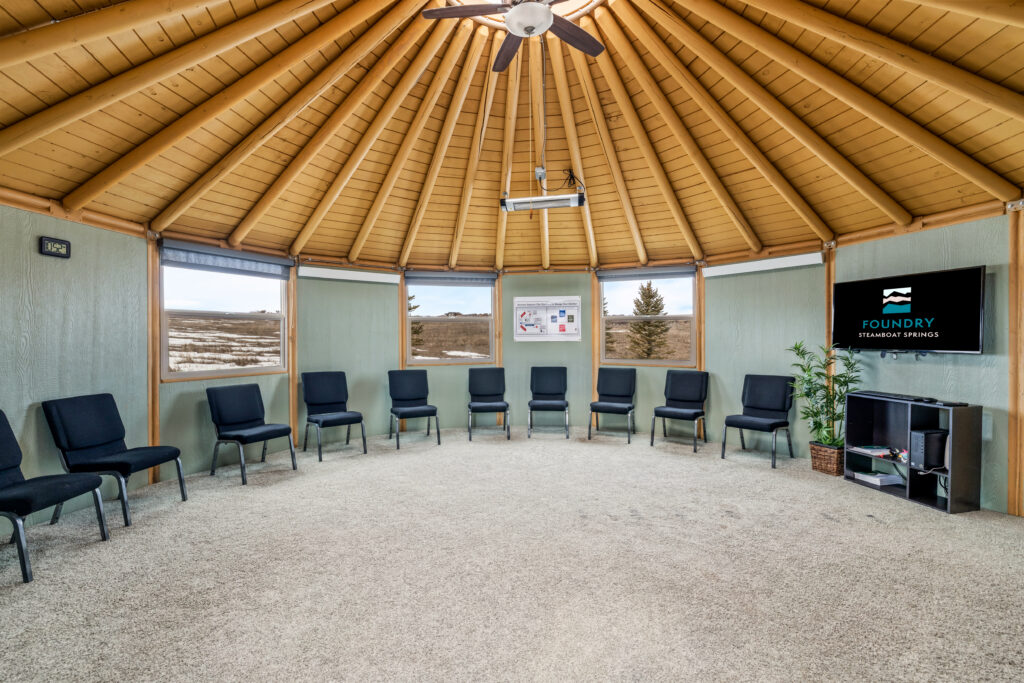
Find peace and support at our beautiful and serene 40-acre ranch-style treatment center in Steamboat Springs, about 30 minutes from the center of town.
This private and peaceful setting includes a comfortable main residence with ample space, comfortable bedrooms, and a kitchen that creates delicious meals using produce grown in our own gardens and greenhouse.

Testimonials
They saved my life. Now 90 days sober/clean. By far the best clinical and therapeutic care I’ve ever experienced in my life. I had been to drug/alcohol treatment before and this is not the same. The staff and physicians actually care about what happens to you and will fight your insurance for more time. Please understand that not everyone will get 90 days but if you are prepared to pay for it out of pocket please do!!! They will work with you and find a payment plan that works. — C.B.
The Foundry’s beautiful setting is matched by their progressive approach in addressing the complex problem of addiction in a complete holistic program that is flexible and adaptable for anyone and everyone. With resources for those in recovery and also their families The Foundry is an amazing place to start a lifelong healing journey. — X.B.
My perspective is that of a parent whose son was at The Foundry for a short time. His serious mental illness did not allow him to stay, however I can say that the Foundry tried everything they could and eventually did right by all of us and our family. I sincerely wish them well, and they will do well because they have they have the residents’ best interest at heart – which is recovery, from addiction and/or mental illness. — C.C.
Such a truly lovely center. They helped my best friend so much. The staff was so obviously caring and I dont know where he’d be without them — K.L.
Our Steamboat Springs, Colorado Location
Foundry Steamboat is located at 1915 Alpine Plaza C3, Steamboat Springs, CO 80487, in Northwest Colorado’s Yampa Valley. Our residential program facility sits on a 40-acre ranch-style property about thirty minutes from the center of town, in a structured, recovery-supportive mountain environment. Our outpatient programming is accessible to clients across Colorado, and Virtual IOP extends access to clients who cannot travel to in-person care.
We treat clients from across Colorado, from the Denver and Boulder metro areas, to Colorado Springs, to rural Western Colorado towns, and beyond.






Insurance and Medicaid Coverage for Hol.istic Addiction Treatment
Foundry Steamboat is in-network with Aetna, Blue Cross Blue Shield, Cigna, Multi-Plan, Rocky Mountain Health, UnitedHealthcare, and proudly accepts all Colorado Medicaid plans. We can work with most major insurance plans.
Please get in touch with an experienced member of our admissions team to verify your insurance benefits, which is a simple and quick process. Foundry Steamboat works with most insurance plans to make its care highly accessible.
Finding out if Foundry Steamboat is covered by your insurance is easy!
Just call us at (844) 955-1066.
Mindfulness in Recovery Within a Coordinated, Evidence-Based Treatment Plan
Mindfulness is one part of recovery. Lasting recovery is built on a coordinated plan that addresses substance use, mental health, family systems, and the practical realities of returning to daily life. At Foundry Steamboat, your mindfulness work (when clinically indicated) sits alongside:
- Individual and group psychotherapy
- Psychiatric care and medication management when appropriate
- Family programming, including structured education and coaching for loved ones
- Nutritional support, movement, and wellness programming
- Continuing care planning that begins on your first day, not your last
The point is integration. Recovery is not a sequence of disconnected services. It is a single direction of care that adapts as you move through it.
Begin Mindfulness-Based Treatment as Part of Addiction Treatment at Foundry Steamboat
Substance use and the trauma that often sits beneath it are treatable. There is never a wrong time to seek help, and there is no obligation in reaching out. Our admissions team can answer your questions, verify your insurance, and help you understand whether residential, PHP, IOP, or Virtual IOP is the right starting point.
If Foundry Steamboat is not the right fit, our team will help you identify an appropriate alternative. Either way, the next conversation does not have to be a commitment: it can simply be a place to start.
Next Steps
- Our straightforward admissions process
- What to bring to treatment at Foundry Steamboat
- Help getting a professional referral
- Meet the team at Foundry Steamboat
- Making waves: Foundry in the media
- Mental health and addiction resources on our blog
Meet Our Wellness Program Director
Kim Brooks, CAT, AAT
Kim Brooks has been with the Foundry in Steamboat Springs since 2015. As Wellness Director, she engages clients in activities to foster whole body wellness with the goal of creating lasting interests and habits that lead to a fulfilling life. Kim enjoys continuously learning and growing and loves being outside, whether it’s pushing her physical limits in endurance sports or finding solace deep in Wilderness Areas. She believes that remaining curious and finding wonder in daily life is important in countering the stresses that our modern lives bring.

Frequently Asked Questions About Mindfulness in Recovery for Addiction
Here are some questions people also ask about mindfulness in recovery for addiction treatment and trauma-informed care more generally.
Is mindfulness the same as meditation, or the same as a therapy like EMDR or CBT?
Not exactly. Meditation is one practice people use to build mindfulness; mindfulness is the broader skill of present-moment, nonjudgmental awareness that you can apply throughout the day. It is not a single therapy on its own — it informs and supports how our clinicians deliver therapies like EMDR, CBT, DBT, psychotherapy, and group work.
Do I need a trauma diagnosis to benefit from mindfulness-based care?
No. While mindfulness is especially relevant for adults with trauma histories, the skills apply broadly. Anyone navigating cravings, anxiety, stress, or difficult emotions in recovery may find a mindfulness practice helpful.
Is mindfulness-based care available in outpatient and Virtual IOP?
Yes. Mindfulness is integrated across our continuum: residential, PHP, IOP, and Virtual IOP. The specifics shift by level of care, but the underlying skills are consistent.
Will my insurance cover mindfulness-based treatment?
Insurance plans cover services like psychotherapy, group therapy, and the broader level of care (residential, PHP, IOP, Virtual IOP). Mindfulness is the practice woven through that care, not a separately billable service. Our admissions team can verify exactly what your plan covers.
How quickly will I notice a difference?
This varies. Some people feel relief simply from having a tool to use in a craving or a stressful moment. Building durable skills usually takes time and consistent practice, and outcomes depend on individual circumstances, level of care, and engagement in treatment.
Is mindfulness scientifically supported for addiction?
Mindfulness-based approaches such as MBRP have been studied for substance use disorders and are used as part of treatment, most often as an adjunct. Research suggests they may help with cravings and emotional regulation, though effects tend to be modest and the evidence is still developing. We apply mindfulness as one part of a coordinated, evidence-informed treatment plan — not as a stand-alone cure.
Can family members participate in mindfulness-based work?
Yes. Our family programming, including work informed by the Michael Barnes Family Institute, helps loved ones build their own self-regulation skills and respond with steadiness rather than escalation. Family involvement is encouraged across levels of care.
Who at Foundry Steamboat delivers mindfulness-based care?
Mindfulness is integrated into the work of our licensed clinicians across residential, PHP, IOP, and Virtual IOP. You can read more about the clinicians who deliver this care on our team page.