

Trauma-Integrated IFS Therapy Within Our Residential, PHP, IOP, and Virtual IOP Programs
At Foundry Steamboat, Internal Family Systems therapy is one of several evidence-based modalities our clinical team uses to address the trauma and emotional patterns that often sit beneath substance use. IFS is not a standalone treatment for addiction. It is a structured therapeutic approach that can support recovery when unresolved inner conflict, protective patterns, and parts-driven behavior continue to drive cravings and relapse risk.
Our team integrates IFS alongside comprehensive residential treatment and detox support, psychiatric care, individual and group psychotherapy, and family programming—a coordinated approach designed to address addiction at every layer.
What Is Internal Family Systems Therapy?
Internal Family Systems, or IFS, is a structured form of psychotherapy developed by Dr. Richard Schwartz that views the mind as a system of distinct “parts”: each with its own emotions, beliefs, and protective roles. During a session, a trained clinician guides the client in turning inward to meet these parts: managers that try to keep daily life under control, firefighters that step in to numb or distract when pain breaks through (often through substances, food, or other compulsive behaviors), and exiles: the wounded younger parts carrying the original hurt, shame, or fear. The work is done from the Self: a calm, curious, compassionate core that IFS holds exists in everyone, even when it feels buried.
The goal of IFS is not to silence or eliminate any part — including the one carrying the addiction. It is to understand why that part took on its role, build trust with it, and access the exiled pain it has been working to protect you from. As exiles are witnessed and unburdened, protective parts no longer need to work so hard, and the beliefs driving substance use (“This is the only thing that works fast enough”; “It’s not safe to feel this”; “I’m too much”) begin to lose their grip.
IFS was originally developed through family therapy and trauma work, and research has continued to examine its application to conditions where parts-driven behavior is central, including substance use disorders and the co-occurring trauma, anxiety, and depression that often sit underneath them. Findings to date suggest IFS may help reduce trauma symptoms and the inner conflict that so often accompanies addiction and substance use disorders.
Why Trauma and Addiction Are So Often Connected
For many people, substance use does not begin as recreation. It begins as a way to manage something overwhelming—anxiety, intrusive memories, chronic shame, loneliness, or the lingering effects of earlier trauma. Alcohol may have quieted racing thoughts. Opioids may have numbed emotional intensity. Stimulants may have countered emptiness or depression. What started as coping can, over time, become dependency.
This pattern is sometimes called self-medication. The underlying mechanism is often unresolved trauma carried by protective parts of the psyche. When those parts work overtime to manage pain, hypervigilance, or fear, substances can temporarily quiet them. Reliance on that effect can deepen into a substance use disorder.
Addiction is not simply a discipline issue. For many of the men and adults who come to Foundry Steamboat, substance use has been layered with histories of trauma, attachment wounds, grief, chronic stress, or shame. Addressing addiction without addressing those underlying patterns can leave clients at higher risk for relapse, which is part of why our care model puts trauma at the center, not at the margins.
An Introduction to the Foundry Steamboat Men’s Residential Addiction Treatment Program
Gender-specific care makes addiction treatment more effective by tailoring programming around the needs of men and creating a comfortable environment where they feel open and engaged.
Deeply ingrained stigmas about addiction and stereotypes about manhood can be sources of profound stress and cause men to suffer in silence. Much of our work focuses on addressing and dispelling these myths, helping men live happier, more authentic lives.
We also address the common and debilitating problem of trauma and neglect, which men can experience at any point in their lives. Our trauma-integrated approach includes evidence-based modalities such as IFS therapy, which may help reprocess the unresolved memories, emotional triggers, and shame-based beliefs that can drive substance use and relapse.
Our highly experienced clinicians, technicians, nurses, doctors, and case managers are specially trained to maintain an emotionally and physically safe environment where clients feel supported and encouraged to do the hard work of treatment.
We’re here to do the work.
- Rigorous schedule of clinical therapy
- High staff-to-client ratio
- Integrated trauma therapy
- Compassionate and involved care team
- Integrated family program
- Comfortable and distraction-free treatment environment
- High quality ongoing care planning
How Internal Family Systems Therapy Works
IFS works from the idea that your mind is made up of distinct “parts”—wounded inner children called exiles, protective managers that keep daily life functioning, and reactive firefighters that step in when pain breaks through. At the center sits the Self: a calm, compassionate core that exists in everyone. In session, your therapist helps you turn inward, get to know each part without judgment, and let Self lead the conversation so protective parts can soften and exiled parts can heal.
Peer-reviewed research supports this approach: a 2025 scoping review found IFS to be a promising treatment for depression, PTSD, and chronic pain, and a randomized controlled trial in The Journal of Rheumatology showed IFS reduced pain and depressive symptoms while improving self-compassion.
How IFS Therapy May Help in Addiction Recovery
Addiction often makes more sense when you stop seeing it as a personal failing and start seeing it as a part of you trying to do a job. In IFS, substance use is usually carried out by a firefighter part — a protector that steps in to numb, distract, or soothe whenever the pain held by exiled parts threatens to break through.
Fighting that part head-on tends to backfire, because it’s been working overtime to keep you safe in the only way it knew how. IFS takes a different approach: getting curious about what your using part is protecting you from, building trust with the exiles underneath, and letting your Self lead the healing instead of shame.
As those wounded parts unburden, the firefighter no longer has to work so hard—and recovery starts to feel less like white-knuckling and more like coming home to yourself.

IFS Therapy Within Foundry Steamboat’s Trauma-Integrated Care Model
Foundry Steamboat is a trauma-integrated treatment program. Trauma is not treated as a side issue or an add-on track, it is a central organizing principle of how our clinicians think about addiction. That orientation shapes when and how we use IFS therapy.
Rather than slotting IFS therapy into a generic schedule, our clinical team evaluates each client’s trauma history, nervous system stability, recovery stage, and goals before recommending trauma processing work. For some clients, IFS therapy is appropriate early in care. For others, the more important first step is stabilization, building grounding skills, strengthening regulation tools, and getting medical and psychiatric support fully in place before targeted memory processing begins.
IFS therapy at Foundry Steamboat is offered alongside individual and group psychotherapy, psychiatric care, evidence-based modalities such as CBT and DBT, family programming through our Michael Barnes Family Institute work, and continuing care planning.
Where IFS Therapy Fits in Your Continuum of Care
IFS therapy is available within several of Foundry Steamboat’s levels of care. The right starting point depends on the severity of substance use, the presence of co-occurring mental health conditions, the stability of the home environment, and the client’s history with prior treatment. Our admissions team can help you understand which level of care fits your situation.
Residential Addiction Treatment
Our men’s residential program in Steamboat Springs provides 24/7 clinical and medical support in a structured, distraction-free setting. For men whose substance use is moderate to severe, whose nervous systems need stabilization before trauma work, or whose home environments are not yet supportive of recovery, residential care creates the foundation IFS therapy may later build on.
Partial Hospitalization Program (PHP)
PHP offers intensive day treatment for clients who need a structured clinical container while transitioning out of residential or stepping up from outpatient care.
IFS therapy within PHP can be sequenced alongside individual therapy, group work, and continuing psychiatric support.
Intensive Outpatient Program (IOP)
Our all-gender IOP allows clients to maintain work, school, or family responsibilities while continuing structured treatment.
IFS therapy sessions can be integrated into the IOP schedule when stabilization, support systems, and recovery routines are sufficient.
Virtual IOP
For clients in Colorado who cannot attend in person, whether due to geography, work, family caregiving, or other obligations, Virtual IOP provides structured intensive outpatient care online.
IFS therapy may be offered virtually for appropriate clients, with attention to the additional safety considerations that telehealth trauma processing requires.
Wellness Activities & Recreation
At Foundry Steamboat, we help men learn how to use movement, sitness training, individual and group recreation, and mindfulness.
Learn to redevelop strong relationships is also an essential part of our care.
Continuing Care Planning
We strive to develop comprehensive and practical continuing care plans allowing men to access affordable, high-quality doctors, psychiatrists, psychologists, support groups, and other recovery resources close to home.
What to Expect in an IFS Therapy Session
An IFS session looks different from talk therapy you may have tried before. Instead of analyzing your week or rehearsing coping skills, you and your therapist turn inward together, slowly, with curiosity, to meet the parts of you that have been carrying the heaviest loads. Most sessions follow a flexible framework Dr. Richard Schwartz developed called the 6 Fs, a step-by-step process for getting to know a part without being overwhelmed by it.
The 6 Fs of IFS
| Step | What It Means | What It Looks Like in Session |
|---|---|---|
| 1. Find | Locate the part in or around your body | “Where do you notice that anxious feeling right now?” |
| 2. Focus | Turn your attention toward it | Slowing down and staying with the sensation or emotion |
| 3. Flesh out | Get to know the part — its age, look, feel | “How old does this part seem? What is it wearing?” |
| 4. Feel toward | Notice how you feel toward the part | This reveals whether you’re in Self or blended with another part |
| 5. beFriend | Build a relationship with the part | Listening to its story, fears, and what it’s been protecting you from |
| 6. Fear | Ask what it’s afraid would happen if it stopped its job | The answer usually points to an exiled part underneath |
Unblending and Unburdening
Two other moments come up often in IFS work. Unblending is the practice of stepping back from a part so you can be with it instead of be it; for example, recognizing “a part of me is furious” rather than “I am furious.” This is what allows Self to lead the conversation.
Unburdening comes later, once an exiled part feels safe enough to share the pain, belief, or memory it has been carrying. With the therapist’s guidance, the part is invited to release that burden, often visualized as letting it go into light, water, or another image that feels right. What replaces it is usually something the part has been missing for a long time: safety, worth, belonging, or rest.
Sessions are typically 50–60 minutes, conversational, and led at your pace. You stay in control of how deep you go and which parts you work with on any given day.
Who Is IFS Therapy For?
IFS is a flexible model, and its reach has grown well beyond its original roots in family therapy and trauma work. Because nearly every mental health and behavioral challenge involves some form of inner conflict (one part of you wanting to change, another part resisting), IFS can support a wide range of conditions, especially those where shame, self-criticism, or protective behaviors are at the center.
Conditions IFS May Help With
- Trauma and PTSD: IFS is especially well-suited to complex trauma, allowing exiled parts to be witnessed and unburdened without retraumatization
- Anxiety: Worrying, perfectionist, and hypervigilant parts often soften as their protective role is acknowledged
- Depression: Inner critics and hopeless parts are met with compassion rather than fought against
- Addiction and substance use disorders: The “using part” is approached as a protector, not an enemy
- Co-occurring disorders: IFS is naturally suited to dual-diagnosis work because it addresses the trauma and emotional pain underneath both conditions at once
- Eating disorders: Restricting, bingeing, and body-image parts are worked with rather than overridden
- Chronic pain: Research has shown IFS can reduce both pain and the emotional load that accompanies it
- Low self-worth, shame, and self-criticism: Core territory for IFS, since these are almost always carried by specific parts
- Relationship and attachment difficulties: Parts that show up in close relationships can be identified, understood, and healed
Who IFS Tends to Resonate With:
IFS often clicks for people who…
- Have tried traditional talk therapy or CBT and felt something was missing
- Notice strong internal conflict (“part of me wants to, part of me doesn’t”)
- Carry shame or self-criticism that hasn’t responded to logic or willpower
- Have a trauma history but feel cautious about diving straight into trauma processing
- Want a therapy that treats them — and every part of them — with compassion rather than judgment
That said, IFS is not a fit for everyone or every moment. Clients in acute psychiatric crisis, active psychosis, or who need immediate stabilization typically begin with other supports first, then move into IFS once they’re grounded. Your clinical team at Foundry Steamboat can help determine whether IFS is the right starting point for you or a piece of a broader treatment plan.

IFS Therapy for Co-Occurring Mental Health Conditions
Many adults entering addiction treatment are also living with co-occurring mental health conditions. These commonly include post-traumatic stress disorder, anxiety, depression, complex trauma, and grief.
IFS is most strongly supported by research as a treatment for trauma and PTSD. At Foundry Steamboat, we treat addiction and co-occurring mental health conditions together rather than sequentially.
Our integrated dual-diagnosis approach means that psychiatric care, individual and group therapy, IFS therapy, and any indicated medication management are coordinated by a single team building a single plan.
What Makes Foundry Steamboat Different
Trauma-Integrated Care Model
Trauma is not a supplementary track in our programming. It is central to how our clinicians understand addiction and how our care is structured. Internal Family Systems Therapy is one of several modalities that fit this approach.
Coordinated Continuum of Care
Detox, men’s residential, PHP, IOP, and Virtual IOP are connected components of a single program — not siloed services. Your continuing care plan begins early and adapts as you progress.
Family Programming Built In
Through our Michael Barnes Family Institute work, family systems support is part of treatment rather than an optional add-on. Loved ones receive structured education, coaching, and the chance to participate in recovery alongside the client.
Gender-Specific Residential, All-Gender Outpatient
Our men’s residential program is built around the specific recovery needs of adult men. Our PHP, IOP, and Virtual IOP programs serve adults of all genders, creating a portfolio that meets clients where they are.
Clinically Serious, Not Lifestyle-Led
Foundry Steamboat is a clinically intensive program. Our care model prioritizes evidence-based treatment, coordinated clinical decision-making, and outcomes awareness over amenity-led positioning.
Our Steamboat Springs, Colorado Treatment Center Location
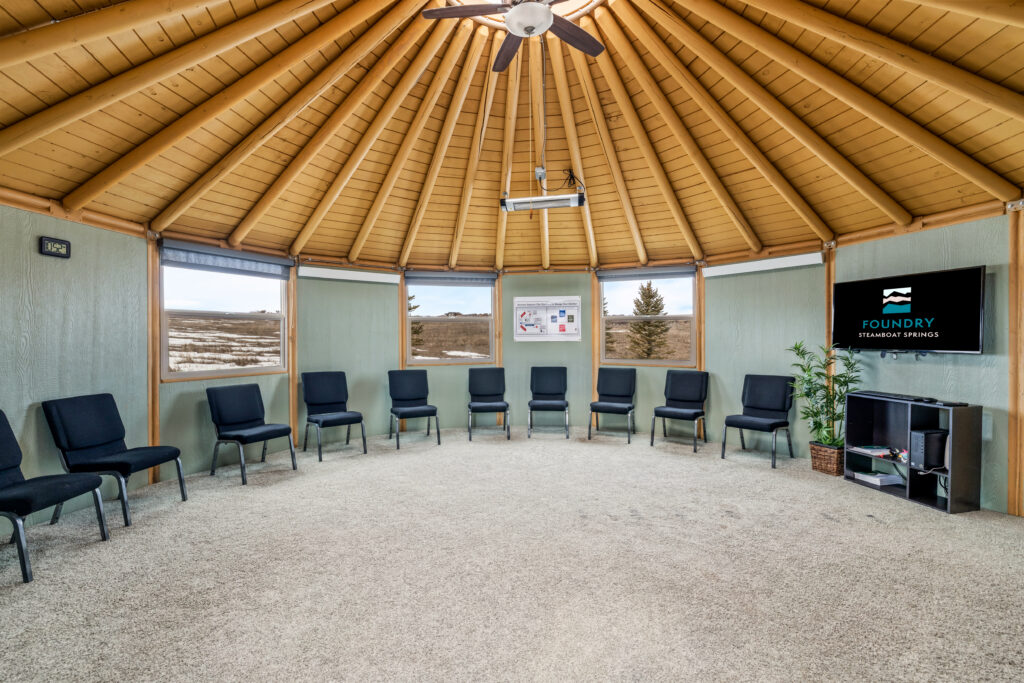
Find peace and support at our beautiful and serene 40-acre ranch-style treatment center in Steamboat Springs, about 30 minutes from the center of town.
This private and peaceful setting includes a comfortable main residence with ample space, comfortable bedrooms, and a kitchen that creates delicious meals using produce grown in our own gardens and greenhouse.

Testimonials
They saved my life. Now 90 days sober/clean. By far the best clinical and therapeutic care I’ve ever experienced in my life. I had been to drug/alcohol treatment before and this is not the same. The staff and physicians actually care about what happens to you and will fight your insurance for more time. Please understand that not everyone will get 90 days but if you are prepared to pay for it out of pocket please do!!! They will work with you and find a payment plan that works. — C.B.
The Foundry’s beautiful setting is matched by their progressive approach in addressing the complex problem of addiction in a complete holistic program that is flexible and adaptable for anyone and everyone. With resources for those in recovery and also their families The Foundry is an amazing place to start a lifelong healing journey. — X.B.
My perspective is that of a parent whose son was at The Foundry for a short time. His serious mental illness did not allow him to stay, however I can say that the Foundry tried everything they could and eventually did right by all of us and our family. I sincerely wish them well, and they will do well because they have they have the residents’ best interest at heart – which is recovery, from addiction and/or mental illness. — C.C.
Such a truly lovely center. They helped my best friend so much. The staff was so obviously caring and I dont know where he’d be without them — K.L.
Our Steamboat Springs, Colorado Location
Foundry Steamboat is located at 1915 Alpine Plaza C3, Steamboat Springs, CO 80487, in Northwest Colorado’s Yampa Valley. Our residential program facility sits on a 40-acre ranch-style property about thirty minutes from the center of town, in a structured, recovery-supportive mountain environment. Our outpatient programming is accessible to clients across Colorado, and Virtual IOP extends access to clients who cannot travel to in-person care.
We treat clients from across Colorado, from the Denver and Boulder metro areas, to Colorado Springs, to rural Western Colorado towns, and beyond.






Insurance and Medicaid Coverage for IFS Therapy
Foundry Steamboat is in-network with Aetna, Blue Cross Blue Shield, Cigna, Multi-Plan, Rocky Mountain Health, UnitedHealthcare, and proudly accepts all Colorado Medicaid plans. We can work with most major insurance plans.
Please get in touch with an experienced member of our admissions team to verify your insurance benefits, which is a simple and quick process. Foundry Steamboat works with most insurance plans to make its care highly accessible.
Finding out if Foundry Steamboat is covered by your insurance is easy!
Just call us at (844) 955-1066.
IFS Within a Coordinated, Evidence-Based Treatment Plan
IFS is one modality. Lasting recovery is built on a coordinated plan that addresses substance use, mental health, family systems, and the practical realities of returning to daily life. At Foundry Steamboat, your IFS work, when clinically indicated, sits alongside:
- Individual and group psychotherapy
- Psychiatric care and medication management when appropriate
- Family programming, including structured education and coaching for loved ones
- Nutritional support, movement, and wellness programming
- Continuing care planning that begins on your first day, not your last
The point is integration. Recovery is not a sequence of disconnected services. It is a single direction of care that adapts as you move through it.
Begin IFS Therapy as Part of Addiction Treatment at Foundry Steamboat
Substance use and the trauma that often sits beneath it are treatable. There is never a wrong time to seek help, and there is no obligation in reaching out. Our admissions team can answer your questions, verify your insurance, and help you understand whether residential, PHP, IOP, or Virtual IOP is the right starting point.
If Foundry Steamboat is not the right fit, our team will help you identify an appropriate alternative. Either way, the next conversation does not have to be a commitment, it can simply be a place to start.
Next Steps
- Our straightforward admissions process
- What to bring to treatment at Foundry Steamboat
- Help getting a professional referral
- Meet the team at Foundry Steamboat
- Making waves: Foundry in the media
- Mental health and addiction resources on our blog
Frequently Asked Questions About IFS for Addiction
Here are some questions people also ask about IFS for addiction treatment and IFS therapy more generally.
Does IFS cure addiction?
No. IFS is not a cure for addiction, and no responsible clinician will describe it that way. IFS is a structured therapeutic approach that may help reduce the inner conflict, protective patterns, and shame-carrying parts that can contribute to substance use. Recovery still involves medical care, ongoing therapy, peer support, and continuing care. IFS works best as one component within a broader, coordinated treatment plan.
How long does IFS therapy take in addiction recovery?
There is no fixed timeline. The length depends on your trauma history, stage of recovery, nervous system stability, and the number of parts involved. Some clients work on a focused set of parts over several months. For others, IFS is a longer-term layer of treatment integrated across levels of care. At Foundry Steamboat, pacing is determined by your clinical team in coordination with you — not by an arbitrary number.
Will IFS make me relapse?
This is a reasonable concern. IFS is structured specifically to reduce that risk. Stabilization comes first — grounding skills, regulation tools, and adequate support are in place before parts work begins. During sessions, emotional intensity is monitored, the work happens at a pace your system can tolerate, and pace is adjusted if distress rises. IFS also does not replace your other recovery supports; it works alongside them. With proper timing, preparation, and a clinical team coordinating your care, IFS can support recovery rather than undermine it.
Can IFS help if my substance use started in adulthood, not childhood?
Yes. IFS does not require childhood trauma to be appropriate. If your substance use began after adult stress, loss, medical trauma, military service, workplace burnout, or relationship breakdown, the parts shaped by those specific experiences can be the focus of the work. The work is on the parts carrying the burden, regardless of when those burdens were formed.
Will my insurance cover IFS therapy?
Coverage for IFS therapy depends on your specific plan and the level of care you are in. Foundry Steamboat is in-network with Aetna, Blue Cross Blue Shield, Cigna, Multi-Plan, Rocky Mountain Health, and UnitedHealthcare, and we accept all Colorado Medicaid plans for outpatient programming. Our admissions team can verify your benefits and walk you through any expected out-of-pocket costs before you make a decision.
What is the difference between IFS and traditional talk therapy for addiction?
Talk therapy focuses on understanding patterns, building insight, and developing coping strategies through verbal exploration. IFS is a structured protocol that works with internal parts, the Self, and the relationships among them — treating the inner world as a system rather than a single voice. Talk therapy and IFS are complementary rather than competing, most clients at Foundry Steamboat continue individual and group therapy alongside IFS when IFS is clinically indicated.
Can family members participate while a client is doing IFS work?
Family involvement is part of our care model at every level. While IFS sessions themselves are a focused one-to-one between the client and clinician, family programming runs in parallel, providing education, coaching, and the chance to address family systems that may have been affected by addiction. Loved ones often play a stabilizing role in the broader recovery work that supports parts processing.